
In this edition
Broadband for All Update
September 2025
The California Department of Technology’s (CDT) Broadband Update provides the latest information on the implementation of the State’s Broadband Action Plan, Middle-Mile Broadband Initiative (MMBI), and other digital equity and inclusion activities, collectively known as Broadband for All.
Subscribe to get monthly updates for Broadband in California.
Community Spotlight
CPUC Approves LifeLine Pilot Program to Improve Broadband for Low-Income Households
On Thursday, August 28, the California Public Utilities Commission (CPUC) approved a three-year LifeLine Home Broadband Pilot Program, which allows low-income households to apply a LifeLine subsidy to a standalone broadband internet service plan. The subsidy offers up to a $20 monthly discount on internet service meeting minimum standards of 100/20 Mbps with 1,280 GB, or $30 for broadband service bundled with a wireline or wireless voice service. There is an additional one-time reimbursement of up to $39/household for new connections.
To learn more about the decision, read the CPUC’s full press release.
Everyone On Expands Digital Equity Efforts Across California
This year, Everyone On, a national digital inclusion nonprofit, expanded its work in California, particularly in the Central Valley, by training 395 residents and distributing computers to 463 residents in Kern and Fresno Counties. This success led to additional private sector funding and a California Public Utilities Commission award. Most recently in Los Angeles, Everyone On pivoted to hybrid learning and home delivery of devices due to ongoing ICE raids. Through the SELA Cares Coalition, immigrant families received vital internet enrollment support, reaching hundreds more households.
Across California, Everyone On continues to close the digital divide by building trust, leadership, and community capacity to ensure every household can thrive in a connected world. To date, Everyone On has provided digital literacy skills training to 5,721 residents, distributed 5,796 devices, and increased capacity for several community groups, who collectively reached more than 63,500 people.
For more information, visit www.everyoneon.org
Please send story ideas related to your work to close the digital divide and foster digital equity to digitalequity@state.ca.gov for consideration in future Broadband for All email updates.
Broadband for All Update
Join us for the Q4 California Broadband Council Meeting
The next California Broadband Council meeting will take place on Friday, October 24 at 9:30 a.m. at CoveredCA – Tahoe Board Room and on Zoom. Presenters will provide updates on the Broadband for All Action Plan implementation, Middle-Mile Broadband Initiative, and Last Mile programs.
To find past meeting recordings, presentations, and minutes, access Broadband for All: Past Events.
Find out what’s new with the Local Jurisdiction Broadband Permitting Playbook
California’s Broadband for All Action Plan directs CDT to explore ways to enhance permitting processes at all levels of government to support broadband deployment in the State. The Local Jurisdiction Broadband Permitting Playbook provides helpful guidance featuring best and smart practices, policy guides, and a checklist for streamlining broadband deployment.
The latest version includes an updated Broadband Glossary, new standards for small wireless facilities, revised guidance on environmental impact reports, batch permitting processes, and additional case studies on broadband-ready policies.
Find the latest version of the Local Jurisdiction Broadband Permitting Playbook on the Broadband for All Portal.
Middle-Mile Broadband Initiative Update
Historic Tribal-State Partnership Brings Broadband to Hoopa Valley
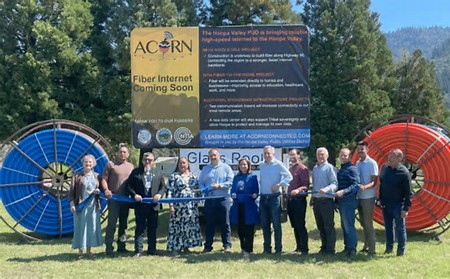
On August 12, the Leadership of the Hoopa Valley Tribe and the Hoopa Valley Public Utilities District hosted CDT and the Secretary for Governmental Operations in a gathering on the ancestral lands of the Hoopa Valley Tribe to celebrate the groundbreaking on the shared joint build project. The event marks the kickoff of construction for nearly 23 miles of high-capacity middle-mile fiber along State Route 96. This joint build partnership provides for a crucial segment of California’s 8,000+ mile open-access middle mile broadband network, and this investment marks a shared commitment to close the digital divide for one of California’s largest and most remote tribal communities.
For the Hoopa Valley community, the project represents new opportunities and better connectivity for this remote community. This portion of the project will support last-mile connections for roughly 1,900 homes and 3,000 residents, supporting the Tribal community by strengthening access
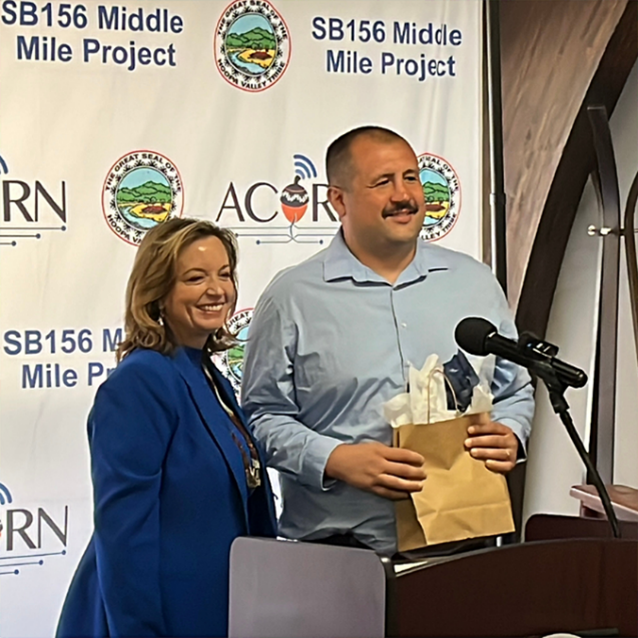
Figure 1: State CIO and Director Liana Bailey-Crimmins presents a gift to Hoopa Valley Tribal Chairman Joe Davis at the Hoopa Valley Tribe groundbreaking on August 12, 2025.
to healthcare, education, economic development, and public safety. This partnership will create a resilient and reliable network that the community can depend on for generations. The event received coverage from local and statewide news outlets, highlighting its importance for both Hoopa Valley and California’s broader connectivity efforts.
Read more about this historic partnership on MMBI What’s New.
North State/North Coast 7th Annual Broadband Summit
The North State Planning and Development Collective hosted the 7th Annual Broadband Summit on August 28. Representatives from CDT, California Emerging Technology Fund, CPUC, and the National Telecommunications Industry Association discussed items on North State broadband internet – including current efforts, legislation, and initiatives to provide summit attendees with information on what’s happening across the North State to help bridge the digital divide. The Deputy Director for the Office of Broadband and Digital Literacy, Scott Adams, and the MMBI Deputy Director, Mark Monroe presented Broadband for All and Middle-Mile updates that pertain to the counties represented by the North State Broadband Connect Consortium. For more information, you can contact Alice Patterson of the North State Planning and Development Collective at ampatterson@csuchico.edu.
Coyote Valley Partnership Expands Middle-Mile Broadband Reach
CDT has entered into a new partnership with the Coyote Valley Band of Pomo Indians, marking another important step in expanding equitable internet access across tribal lands. Unlike fiber construction projects, this partnership focuses on the placement of a key state-of-the-art network hut directly on Coyote Valley tribal land to house the electronics powering the network.
Access to this high-capacity infrastructure will allow Coyote Valley tribal members to participate fully in distance learning and telehealth, pursue business opportunities, and safeguard their cultural and community institutions with the tools they need to thrive in a digital world.
This agreement is part of a growing series of partnerships between CDT and Tribal Nations, reflecting a shared vision that closing the digital divide is inseparable from strengthening tribal resilience and long-term opportunities.
Installation Updates
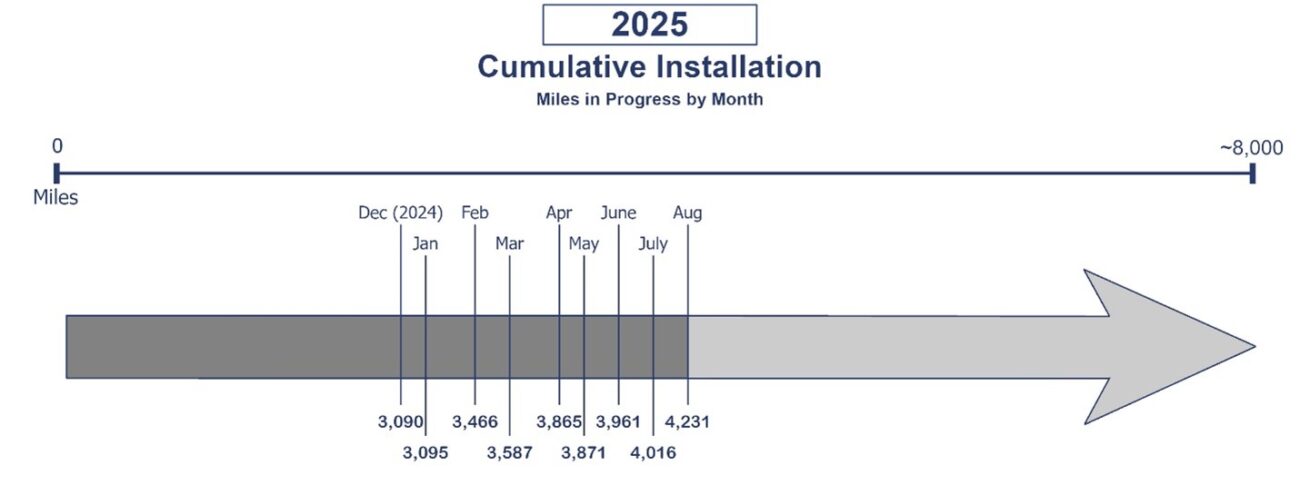
The MMBI team continues to make significant progress across the state. Approximately 4,231 miles, more than half of the planned network footprint, has gone to installation through CDT’s joint build, IRU/lease, purchase partnerships, and Caltrans. Here is the breakdown of updates as of August 2025.
Caltrans Construction Highlights:
Caltrans continues to make progress, having completed preconstruction on all 266 of its miles and having moved to installation on approximately 230 miles of the network as projects move from preconstruction to installation. Installation started this month on an approximately 6-mile segment in San Diego County along State Route 54.
Joint Build & Lease Highlights:
Siskiyou Telephone Company (Siskiyou Tel) Project: Installation from one of our joint build network partners, Siskiyou Tel (covering approximately 164 miles), started in August on an approximately 44-mile segment in Siskiyou County along State Route 96.
Lumen Technologies Joint Build & IRU projects: Installation from one of our network partners, Lumen Technologies (covering over 1,800 miles across 20 different segments) has also made substantial progress. Installation started this month for the following two segments of approximately:
- 134 miles from the City of Riverside to the City of Niland in Riverside, San Bernardino, and Imperial counties.
- 31 miles from the City of Niland to the City of El Centro in Imperial County.
Last Mile Program Update
California Advanced Services Fund (CASF)
Keep in mind key application deadlines for the following:
- Tribal Technical Assistance Grant Program: October 1, 2025
- Broadband Infrastructure Grant Account: October 31, 2025
- Broadband Adoption Account: January 1, 2026
- Broadband Public Housing Account: January 1, 2026
Tribal Technical Assistance Grant Program
On July 14, 2025, the CPUC awarded $250,000 in grant funding through the Tribal Technical Assistance program to the Big Sandy Rancheria Band of Western Mono Indians of California to develop the Big Sandy Tribal Fiber to Premise and Sustainability Study.
Broadband Infrastructure Grant Account
Visit the CASF Broadband Infrastructure Grant Account website for more information, including content and recordings of recent instructional webinars. The California Interactive Broadband Map has been updated to display end-of-year 2023 broadband availability and adoption data collected by CPUC. User guide, public feedback information, and other resources are available on the Broadband Mapping page.
Broadband Adoption Account and Broadband Public Housing Account
On July 24, 2025, CPUC provided $1.2 million in grant funding through the Broadband Adoption Account to support 10 digital literacy projects across California. Additionally, CPUC awarded $224,050 in grant funding for four broadband infrastructure projects through the Broadband Public Housing Account to provide free, high-speed internet service to 95 households in Kern and Santa Cruz counties. In addition, the Broadband Adoption Account provided 54 ministerial awards to 22 grantees (totaling $6.2 million) and the Broadband Public Housing Account provided 23 additional ministerial awards to four grantees (totaling $1.3 million).
Find out more about the California Advanced Services Fund programs and awards.
Federal Funding Account
CPUC last mile Federal Funding Account Round 2 application window for the six counties of Calaveras, Contra Costa, Inyo, Monterey, Orange, and Trinity closed on June 2, 2025. CPUC received 72 applications for approximately $600 million in grant requests and is conducting an overall review and evaluation of these applications.
Visit the Federal Funding Account Application Resources and 2025 Data and Public Map webpages for more information.
Digital Equity and Broadband Equity, Access, and Deployment Updates
Broadband Equity, Access, and Deployment Program (BEAD)
CPUC adopted Decision 23-02-016 to update the BEAD program in accordance with the National Telecommunications and Information Administration’s (NTIA’s) BEAD Restructuring Policy Notice. Application materials were updated to reflect revised federal requirements. The BEAD 2.0 Benefit of the Bargain Round (for Subgrantee Selection) Project Application window closed on August 2, 2025.
CPUC is reviewing Project Applications in accordance with the process outlined in the CPUC’s Initial Proposal Volume 2 and the BEAD Restructuring Policy Notice. The NTIA has approved a deadline of October 2, 2025, for the state to submit its Final Proposal.
We encourage interested parties to visit the CPUC’s BEAD Subgrantee Selection webpage for the latest BEAD updates, resources, and Frequently Asked Questions (FAQs). Webinar recordings and slide presentations are available on the BEAD Events page.
Broadband Adoption Update
Low-Cost Offer Finder Tool
Home internet service and computing devices are critical for all individuals to reap the social and economic benefits of the digital world. The cost of both remains a barrier for many people.
To find affordable broadband service and computing devices, CDT has partnered with Everyone On to help California residents find affordable service programs in their area by zip code.
The low-cost offer finder tool provides access to low-cost internet services, computer equipment, and digital skills training.
State Digital Equity Plan Update
Register for the September 12 Digital Equity Stakeholder Briefing
Please join CDT for a Digital Equity Stakeholder Briefing on Friday, September 12, from 11:00 a.m. to 12:00 p.m.
CDT will share the status of the Digital Equity Act programs and provide updates on existing resources and digital equity work moving forward.
Digital Equity Resource Finder
The Digital Equity (DE) Resource Finder tool has been developed with the digital equity practitioner network as the initial primary user. The finder has been populated with data collected during the development of the SDEP, including Digital Equity Ecosystem Mapping(DEEM) data, regional public meetings, and engagement with digital equity partners. Future iterations of this tool will be developed in partnership via ongoing work efforts of SDEP implementation. Please use this form to add your organization, update your organization’s information, or remove your organization.
For any questions, please contact the team at DEEM@state.ca.gov.
Funding Opportunities
Broadband for All Portal Funding Finder
OBDL tracks funding opportunities as they become available and strives to keep the Broadband for All portal up to date with information on broadband deployment, adoption, and digital literacy planning and implementation. Find these opportunities here.
Upcoming Events
**Find materials from past events.
| Date | Time | Event | Locations and Links |
| Friday, September 12, 2025 | 11:00 am – 12:00 pm | Digital Equity Stakeholder Briefing (Virtual) | |
| Friday, October 17, 2025 | 10:00 a.m. – 12:00 p.m. | Middle-Mile Advisory Council Meeting (Hybrid) | Sacramento County Administration Center 700 H St., 1st Floor, Sacramento, CA 95814 Meeting Details |
| Friday, October 24, 2025 | 9:30 – 11:30 a.m. | California Broadband Council Meeting (Hybrid) | CoveredCA 1601 Exposition Blvd, Sacramento, CA 95815 Zoom |
Job Opportunities
Keep an eye on CDT Broadband job postings and CPUC job postings. Visit CalCareers for more information and to apply for open positions.


