
Broadband for All Update
February 2026
The California Department of Technology’s (CDT) Broadband Update provides the latest information on the implementation of the State’s Broadband Action Plan, Middle-Mile Broadband Initiative (MMBI), and other digital equity and inclusion activities, collectively known as Broadband for All.
Subscribe to get monthly updates for Broadband in California.
Community Spotlight
NDIA Recognizes Local Organizations and Tribal Entities Advancing Digital Equity
The National Digital Inclusion Alliance (NDIA), a national non-profit which advances digital equity, recognized 58 local governments and tribal entities across 25 states for their contribution to digital equity. Congratulations to the 11 California municipal, county, regional governments, and tribal entities that are paving the way and providing excellent models for digitally inclusive communities. Below are the awardees by NDIA categories:
- Visionary Digital Inclusion Trailblazers: City and County of San Francisco, City of Fairfield, City of Long Beach, City of Oakland, City of San Diego, City of San Jose, City of Vacaville, and County of Los Angeles.
- Digital Inclusion Trailblazers: City of Palmdale, and Housing Authority of the City of Los Angeles.
- Seven Star Communities: Hoopa Valley Public Utilities District
Find more information on NDIA 2025 Digital Inclusion Trailblazers and 2025 Seven Start Communities.
CPUC Approves Verizon-Frontier Acquisition and Public Benefits Agreements
The California Public Utilities Commission approved Verizon’s acquisition of Frontier Communications, along with three Public Benefits Agreements for Cal Advocates, the California Emerging Technology Fund (CETF), and the Communication Workers of America. These agreements will expand fiber service to 75,000 households, install 250 towers, provide affordable internet offers, invest $40 million in Digital Inclusion to connect and provide digital skills for 100,000 households, commit $500 million to increase small business supplier diversity, and create 600 new union jobs.
CETF will administer the $40 million Digital Inclusion investment to advance its mission and also manage $1 million to engage workforce development and small business assistance programs. CETF will host listening sessions in March and April to gather stakeholder input and deliver measurable outcomes. If interested in attending, please contact CETF Senior Vice President Kat Zigmont by emailing cetf_communications@cetfund.org.
Per Scholas Los Angeles Launches Digital Navigator Program
Per Scholas is a national non-profit that empowers learners with rigorous technology and AI training for tech careers and connect skilled talent to leading businesses. Through a grant received from the Los Angeles County Department of Economic Opportunity High Road Training Partnership (HRTP) Fund, Per Scholas Los Angeles will begin offering no-cost training in IT support, data center operations, and cybersecurity, along with paid work experience providing digital literacy to local communities while creating pathways to growing tech careers.
Qualified learners must be 18+, LA County residents, and available for full-time hands-on learning and training. Upon completion, candidates will be placed with HRT partners, earning $20 – $26 hourly based on skills and experience, and the chance to earn industry-recognized certifications.
To apply, visit Per Scholas Los Angeles website.
Please send story ideas related to your work to close the digital divide and foster digital equity to digitalequity@state.ca.gov for consideration in future Broadband for All email updates.
Broadband for All Update
Thank you for tuning in to Q1 California Broadband Council
The first California Broadband Council (CBC) meeting of the year took place on Friday, January 23 at a new location in the Sacramento County Administration Center and on Zoom. CDT and CPUC presented Broadband for All Action Plan Review and Revision Process, Middle-Mile Broadband Initiative, and Last Mile programs. The meeting featured a member spotlight on the California State Library and a community spotlight on the San Francisco-based non-profit Dev/Mission.
To find past meeting recordings, presentations, and minutes, access Broadband for All: Past Events.
Middle-Mile Broadband Initiative Update
Network Hut Delivery Advances Construction
This month, the California Department of Technology (CDT) delivered a new network hut to its designated site in the City of San Fernando, another milestone in building the statewide open access Middle-Mile Broadband Network (MMBN). Hut delivery and placement are part of the broader construction process underway across the state. These climate-controlled structures house the electronics needed to operate the middle-mile network and serve as backbone support points, allowing fiber-optic routes to connect.
This first hut was delivered on January 8, 2026, after site preparation was completed. The hut will support network operations and help move the project closer to connecting communities to the statewide network once power and electronics are installed.
Q1 2026 Middle-Mile Advisory Committee Meeting
The Q1 Middle-Mile Advisory Committee (MMAC) meeting was held on January 16, 2026, at the Sacramento County Board of Supervisors building and online via Zoom. The Committee heard the latest updates on the Middle-Mile Broadband Initiative (MMBI) from CDT and its partners at Caltrans and GoldenStateNet (GSN). The California Public Utilities Commission (CPUC) also provided updates on the last-mile programs that focus on last-mile connections and on the continued coordination efforts with CDT and last-mile grant recipients connecting to the MMBI network.
During the meeting, CDT highlighted the progress of the MMBI, sharing construction updates and operational milestones. In addition, CDT welcomed two guest speakers, Tribal Chairman Steven Orihuela of the Bishop Paiute Tribe, and Sarah McCormick, the Housing and Economic Development Manager for the City of Fort Bragg. These guest speakers shared updates on the work happening in their communities, including installation progress in the City of Fort Bragg, and the Bishop Paiute Tribe’s upcoming connection to the MMBN through the Digital 395 segment. The recordings, transcripts, and presentations will be available on the Past Meeting Resources page on the MMBI website in the coming weeks. More information about the MMAC can be found on the Meetings page.
MMBI Stakeholder Engagement
CDT held its first quarterly (Q1) Middle-Mile Stakeholder Engagement meeting for the year on January 31, 2026. These sessions are designed for stakeholders and partners to ask questions and receive project updates. For more information about these meetings, you can contact CDT by sending an email to middlemile@state.ca.gov.
Installation Updates
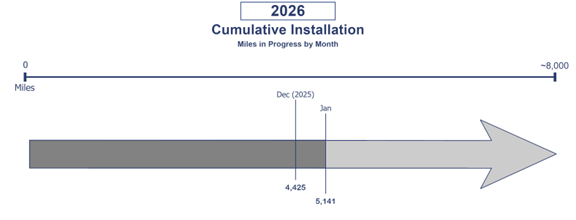
The MMBI is making significant progress across the state. Nearly 5,200 miles have been moved into installation through CDT’s joint build, IRU/lease, purchase partnerships, and Caltrans.
Here is the breakdown of updates as of January 2026:
Joint Build & Lease Highlights:
CVIN Lease Project: Started installation on approximately 716 miles across various counties.
Last Mile Program Update
Federal Funding Account
California has invested $1.23 billion through the last mile Federal Funding Account run by the California Public Utilities Commission (CPUC). These investments expand affordable and reliable high-speed internet access statewide. The broadband infrastructure projects will benefit an estimated 2 million Californians across the state’s 58 counties. The Federal Funding Account investments bring California closer to achieving Broadband for All and further bolster resilience, public safety, and access to services and opportunities. Most recently, the CPUC awarded $21 million for investments supporting four projects in Contra Costa, Inyo, and Monterey Counties in January 2026.
Last Mile Investments by the Numbers:
- $1.23 billion in grants approved
- 122 broadband projects approved
- 58 counties with broadband projects
- 2 million Californians benefitting from broadband projects
- 7,500 miles of fiber-optic cable lines proposed for construction
- 47 entities received broadband project grants
- Average project size of 37 square miles and $10 million in grant funds
- 120 of 122 projects (98%) include an affordable plan (low-income, low-cost, and or bundled broadband and voice plan)
For more information, please visit:
- Federal Funding Account Recommendations and Awards
- CPUC Expands Broadband Access Statewide with Approval of Projects
California Advanced Services Fund (CASF)
The CASF Rural and Urban Regional Broadband Consortia Account is accepting grant applications until February 20, 2026. New and existing Consortia are invited to apply as well as applicants for Consortia Regions that are not currently represented. An application cycle for Tribal Consortia will be announced. For more information, please visit:
- CASF Rural and Urban Regional Broadband Consortia Account
- Notice of New Application Cycle for CASF Rural and Urban Regional Broadband Consortia Account Grant Funding and Information for Current Consortia (December 10, 2025)
Interested entities can prepare to apply to these CASF grant programs with upcoming application windows:
- Tribal Technical Assistance Account – April 1, 2026 (quarterly windows)
- Broadband Adoption Account – July 1, 2026
- Broadband Public Housing Account – July 1, 2026
The CASF Broadband Infrastructure Grant Account team is evaluating 2025 grant applications requesting approximately $424 million to provide broadband internet access to over 18,000 households. Project information is available at CASF Applications – Project Summaries and Maps.
Broadband Equity, Access, and Deployment Program (BEAD)
On December 18, 2025, the CPUC unanimously approved California’s BEAD Final Proposal (Resolution T-17898) for submission to the National Telecommunications and Information Administration (NTIA). The CPUC submitted its Final Proposal to the NTIA the following day. The Final Proposal builds on the previously approved Initial Proposal, modified in accordance with the BEAD Restructuring Policy Notice, and includes a list of preliminary awards to applicants selected for BEAD grant funding through the BEAD Subgrantee Selection Process.
All subgrant awards are dependent upon review, acceptance, and approval by NTIA and the CPUC continues to work with NTIA toward approval of its Final Proposal.
For more information, please visit the California BEAD Final Proposal webpage and this press release: CPUC Finalizes BEAD Plan to Secure Up to $1.86 Billion.
Broadband Affordability Update
Digital Divide Grant Program
The CPUC is accepting applications for the Digital Divide Grant Program until February 12, 2026. The grants are aimed at reducing the digital divide in schools and communities located in low-income urban and rural areas by providing necessary resources and access to digital technology. Learn about the program and who is eligible to apply in the Digital Divide Grant Program Round 3 Informational Flyer.
California LifeLine Home Broadband Pilot Program
On January 26, 2026, the CPUC launched the California LifeLine Home Broadband Pilot Program, which is a three-year, technology-neutral pilot for eligible households to apply California LifeLine subsidies to any internet plan meeting minimum service standards and approved by the CPUC. Eleven internet service providers, including Comcast and Charter/Time Warner/Brighthouse have registered to participate to date. California LifeLine has provided affordable voice service to Californians for years, and this pilot program will help close the broadband affordability gap. Internet providers can file to participate in the pilot and learn more on the CPUC’s LifeLine program webpage. Households will be able to learn more about eligibility and instructions on the California LifeLine webpage.
The Home Broadband Pilot Program supports:
- Minimum speeds of 100/20 Mbps and 1,280 GB usage per month
- Subsidies of $20/month for broadband ($30 when bundled with voice from the same provider)
- Up to $39 reimbursement per year for new connections
Broadband Adoption Update
Low-Cost Offer Finder Tool
To find affordable broadband service and computing devices, CDT has partnered with Everyone On to help California residents find affordable service programs in their area by zip code.
The low-cost offer finder tool provides access to low-cost internet services, computer equipment, and digital skills training.
State Digital Equity Plan Updates
January Digital Equity Community of Practice Meeting Recap
On January 30, CDT kicked off 2026 Community of Practice with more than 270 registered attendees. Responsive to feedback, CDT hosted a panel discussion with LA County, Solano County, and Fresno County librarians on Digital Inclusion Library Programs. Other presenters provided updates on the Digital Equity Resource Survey findings, BB4All and SDEP Request for Innovative Ideas, and upcoming grant opportunities. Join the next Community of Practice meeting on Thursday, February 26 at 10:30 a.m.
If you missed this meeting, please find past meeting recordings, presentations, and minutes on Broadband for All: Past Events.
Funding Opportunities
Broadband for All Portal Funding Finder
The funding finder tracks broadband deployment, adoption, and digital literacy funding opportunities as they become available. Find these opportunities here.
Upcoming Events
**Find materials from past events. See future calendar events.
| Date | Time | Event | Locations and Links |
| Thursday, February 26, 2026 | 10:30 a.m. – 12:00 p.m. | Digital Equity Community of Practice (Virtual) | Register |
| Friday, April 17, 2026 | 10:00 am – 12:00 pm | Middle-Mile Advisory Council Meeting (Hybrid) | Sacramento County Administration Center 700 H St., 1st Floor, Sacramento, CA 95814 Meeting Details |
| Friday, April 24, 2026 | 9:30 am – 11:30 am | California Broadband Council Meeting (Hybrid) | Sacramento County Administration Center 700 H St., 1st Floor, Sacramento, CA 95814 Zoom Webinar |
Job Opportunities
The California Department of Technology is hiring across many teams to support Broadband for All. Apply using the link below. Keep an eye on CDT Broadband job postings and CPUC job postings. Visit CalCareers for more information and to apply for open positions.


