
In this edition
Broadband for All Update.
June 2026
The California Department of Technology’s (CDT) Broadband Update provides the latest information on the implementation of the State’s Broadband Action Plan, Middle-Mile Broadband Initiative (MMBI), and other digital equity and inclusion activities, collectively known as Broadband for All.
Subscribe to get monthly updates for Broadband in California.
Featured Story
California’s Middle-Mile Network Moves into Operations with Skyline Technology Solutions
On April 17, 2026, the CDT officially selected Skyline Technology Solutions as the network operator for the state’s Middle-Mile Broadband Network (MMBN) following a rigorous and competitive procurement process.
Skyline brings experience in network engineering, cybersecurity, managed services, and operating large-scale state networks, most notably NetworkMarylandTM
The company has operated Maryland’s statewide network since 2010, making them one of the few operators in the country with direct, comparable experience in operating a network of similar scale to what California is building.
As the operator, Skyline will support 24/7/365 network monitoring and security, statewide field dispatch and maintenance, incident response, and meeting service level requirements across active segments. Operational onboarding activities began immediately following the announcement.
On May 7, CDT, Skyline, and GoldenStateNet held a formal, in person operator kickoff meeting. The session brought together leadership and technical teams from all three organizations to align on roles, responsibilities, and the path to July service activation for the first portion of the network.
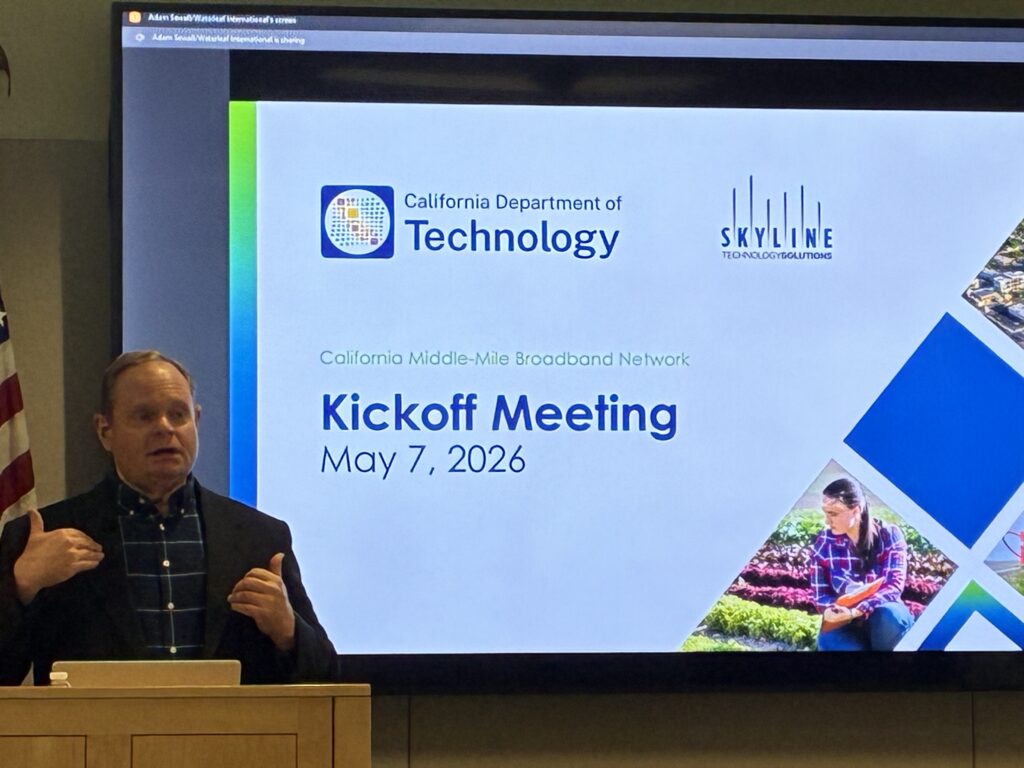
“Skyline is honored to support CDT, GoldenStateNet, and the State of California as the Middle-Mile Broadband Network moves from vision to operation. This is critical infrastructure for California’s future, and we look forward to bringing our statewide network operations experience to help deliver the reliability, security, and responsiveness this mission requires.”
— David Parsha, Chief Revenue Officer, Skyline Technology Solutions
What began as a statewide vision to expand broadband access for unserved and underserved communities is now becoming an operational network, with active connections already serving Californians.
Community Spotlight
North State Planning and Development Collective published the Spring 2026 Broadband Workforce Report
The North State Planning and Development Collective’s Spring 2026 broadband workforce report reaffirms broadband as essential infrastructure for rural communities, noting persistent challenges such as high deployment costs, difficult terrain, and limited cross‑jurisdictional coordination. The study evaluates labor supply, training programs, and workforce capacity across the Northeastern and Upstate California Connect Consortium areas.
Findings point to skill gaps, rural workforce limitations, and a misalignment between employer needs and current training pathways. The report emphasizes that strengthening the region’s broadband workforce will require coordinated action among employers, education partners, regional consortia, and community stakeholders to support a more connected and economically resilient North State.
Click here for the full report or visit: www.nspdc.csuchico.edu.
USDA Grant Opportunity: Expanding Rural Access to Distance Learning & Telehealth
The U.S. Department of Agriculture (USDA) Rural Development is currently accepting applications for the Distance Learning & Telemedicine (DLT) Grant Program. The program will help rural communities expand access to education, telehealth, and workforce training through improved technology and connectivity.
Applications opened May 1, 2026, and deadline is on June 30, 2026. Grant awards range from $50,000 to $750,000 and require a 15% match.
Learn more and apply at USDA Distance Learning & Telemedicine Grant Program.
Please send story ideas related to your work to close the digital divide and foster digital equity to digitalequity@state.ca.gov for consideration in future Broadband for All email updates.
Broadband for All Update
Looking Ahead: Q3 California Broadband Council Meeting on July 24
The next California Broadband Council (CBC) meeting will take place on Friday, July 24 at the Sacramento County Administration Center and on Zoom. There will be updates on the progress of the Broadband for All Action Plan, Middle-Mile Broadband Initiative, Last Mile programs, and Adoption Initiatives.
Prepare ahead for the upcoming meeting by reviewing past recordings, presentations, and minutes in the Broadband for All: Past Events.
Middle-Mile Broadband Initiative Update
Lighting the Network: The Critical Role of Broadband Huts

With roughly half of the Middle-Mile Broadband network’s fiber miles constructed, the initiative is entering another critical phase: the installation of network huts.
Spread across roughly 8,000 miles of middle-mile network, 136 huts will be installed with one hut located approximately every 50 miles. Huts, these modest-looking structures, may not attract the same attention as miles of installed fiber, but they are among the most important components of the entire network. Without huts, there is no operational network. If you think of fiber as the highway, the huts are the interchanges, amplification points, and control centers that keep information moving across the network.
Read more about the progress on hut installation via CDT Newsroom.
Installation Updates as of May 26
The MMBI continues to make progress across the state. Below is a snapshot of the network’s status as of May 2026:
MMBI by the Numbers
Total network miles: 8,209
All 58 counties reached
Miles in preconstruction phase: 2,787
Miles in installation phase: 4,999
Miles Ready-to-Connect: 423
9 tribal partnerships and engagements
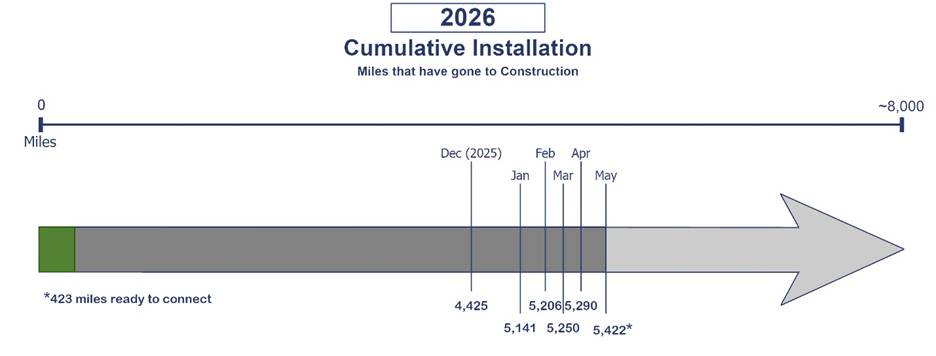
Of the entire network, 423 miles are currently ready to connect, 4,999 miles are in installation, and 2,787 miles remain in preconstruction.
Of the 8,209-mile network, 5,421 miles have gone to construction, of which 1,617 miles are currently in construction. 3,381 miles of fiber have been completed and 423 miles are operational.
Breakdown of Updates as of May 2026:
Joint Build & Lease Highlights as of May 2026:
- American Dark Fiber recently started installation on:
- 50 miles along Interstate 50 in San Bernardino County
- 25 miles along Highway 50 in Sacramento County
- Arcadian recently started installation on:
- 25 miles adjacent to Highway 20 in Mendocino County
- 31 miles spread across multiple counties including: Alameda, Marin, Orange, Siskiyou, Sonoma and Tuolumne.
Hut Highlights:
As of the end of May, MMBI had 32 hut sites in construction:
- As of April, 22 huts are under construction in various counties.
- In May, 10 huts started construction in Sonoma, Siskiyou, Tehama, Kern, Lassen, Modoc, Tulare, San Bernardino, and Riverside counties.
Last Mile Program Update
California Advanced Services Fund (CASF)
Current program highlights follow. For the most up to date information, please visit the California Advanced Services Fund website.
Broadband Grant Opportunities and Updates
Four CASF grant programs have upcoming application windows. Interested entities can prepare to apply to these programs:
- Tribal Technical Assistance Account – July 1 and October 1, 2026
- Broadband Adoption Account – July 1, 2026
- Broadband Public Housing Account – July 1, 2026
- Broadband Infrastructure Grant Account — October 1, 2026
The California Public Utilities Commission (CPUC) postponed the CASF Broadband Infrastructure Account 2026 grant application deadline from April 1, 2026, to October 1, 2026. View the complete revised schedule: Postponement of the Deadline for Action on Pending 2025 CASF Infrastructure Applications and 2026 CASF Infrastructure Project Application Deadline.dline.
Broadband Loan Loss Reserve Fund
The Broadband Loan Loss Reserve Fund helps CPUC grant projects with local broadband infrastructure financing. The CPUC is seeking comments on a proposed Direct Loan Option to help entities complete projects funded by the CPUC. As described in Draft Resolution T-17925, program updates include a streamlined process to award bridge funding. The earliest the CPUC will consider these updates will be at its June 11, 2026, Voting Meeting.
More information is available on the program website at Broadband Loan Loss Reserve Fund.
Last Mile Federal Funding Account
California has invested $1.23 billion through last mile Federal Funding Account grants to 122 broadband infrastructure projects in all 58 counties. These last mile fiber projects bring affordable broadband access directly to rural, tribal, and low-income communities across California. For the most up to date information, visit the CPUC’s webpage at Federal Funding Account Recommendations and Awards.
Broadband Equity, Access, and Deployment Program (BEAD)
California awaits updates from the National Telecommunications and Information Administration (NTIA) about approval of the state’s BEAD Final Proposal for awards to applicants selected through the BEAD Subgrantee Selection Process.
For the most up to date information, please visit the California BEAD Final Proposal webpage.
Broadband Affordability Update
California LifeLine Home Broadband Pilot Program
The CPUC launched the California LifeLine Home Broadband Pilot Program earlier this year. The technology-neutral pilot program helps lower the monthly cost of home internet service for eligible low-income households. Learn how the pilot program is Making Home Internet More Affordable for Californians by building on the experience of providing affordable voice services through California LifeLine.
To see if this program is available in your area and sign up, visit the California Lifeline website.
State Digital Equity Plan Updates
May Digital Equity Community of Practice Recap
Thanks to all the digital inclusion partners and stakeholders who attended the May Digital Equity Community of Practice. We are pleased to hear from a variety of subject matter experts on critical topics, including:
- A Panel on Technology Access for Disabled Individuals facilitated by Andrew Broderick, SF Tech Council, including:
- Jacob Johnson, CA Department of Rehabilitation
- Mark Bella, California Connect/ Deaf and Disabled Telecommunications Program (DDTP)
- Ryan Easterly, WITH Foundation
- Marisol Ferrante, Independent Living Resource Center SF
- An Update on USDA Distance Learning & Telemedicine GrantbyRobert Machado, USDA Telecom General Field Representative
Participants also heard from CPUC on the status of the California LifeLine Home Broadband Pilot Program and CDT about tools, resources, and future grant opportunities to support digital inclusion efforts. Register for the next Community of Practice on Thursday, June 25 at 10:30 a.m. via Zoom.
If you missed this meeting, please find past meeting recordings, presentations, and minutes on Broadband for All: Past Events.
Tools and Resources
Digital Equity Resource Finder
California’s Digital Equity Resource Finder is a statewide tool that helps residents find digital inclusion programs right in their communities, such as assistance in enrolling affordable home internet, obtaining free or low-cost devices, digital skills training, and more. The Resource Finder is searchable by location and updated by organizations across the state.
Know someone who needs support getting connected? Send them to the Digital Equity Resource Finder.
If your organization would like to add your digital inclusion services to the Finder, click on the Add Resource button at the top of the page or complete this form to submit your information.
Low-Cost Offer Finder Tool
To find affordable broadband service and computing devices, CDT has partnered with Everyone On to help California residents find affordable service programs in their area by zip code.
The low-cost offer finder tool provides access to low-cost internet services, computer equipment, and digital skills training.
Broadband for All Portal Funding Finder
The funding finder tracks broadband deployment, adoption, and digital literacy funding opportunities as they become available. Find these opportunities here.
Upcoming Events
**Find materials from past events. See future calendar events.
| Date | Time | Event | Locations and Links |
| Thursday, June 25, 2026 | 10:30 a.m. – 12:00 p.m. | Digital Equity Community of Practice (Virtual) | Register on Zoom |
| Friday, July 17, 2026 | 10:00 am – 12:00 pm | Middle-Mile Advisory Council Meeting (Hybrid) | Sacramento County Administration Center 700 H St., 1st Floor, Sacramento, CA 95814 Meeting Details |
| Friday, July 24, 2026 | 9:30 am – 11:30 am | California Broadband Council Meeting (Hybrid) | Sacramento County Administration Center 700 H St., 1st Floor, Sacramento, CA 95814 Zoom Webinar |
Job Opportunities
Keep an eye on other CDT Broadband job postings and CPUC job postings. Visit CalCareers for more information and to apply for open positions.


