
In this edition
Broadband for All Update.
September 2026
The California Department of Technology’s (CDT) Broadband Update provides the latest information on the implementation of the State’s Broadband Action Plan, Middle-Mile Broadband Initiative (MMBI), and other digital equity and inclusion activities, collectively known as Broadband for All.
Subscribe to get monthly updates for Broadband in California.
Community Spotlight
Los Angeles County Releases Its First Digital Equity Roadmap
Los Angeles County (LA County) has reached an exciting milestone with the release of its inaugural Digital Equity Roadmap, a three-year action plan designed to close the digital divide and ensure that every resident has access to reliable internet, devices, digital skills training, AI literacy, navigation support, and workforce development opportunities.
Developed collaboratively with County departments, community ambassadors, partner organizations, and stakeholders, this roadmap lays the foundation toward a digitally resilient Los Angeles County where every household can fully participate in today’s digital world. LA County will soon host the LA County Connected: Digital Equity Roadmap Action Summit in October during National Digital Inclusion Week, marking the official start of roadmap implementation. Organizations interested in supporting digital inclusion efforts can submit an Implementation Commitments Form by October 30, 2026.
To view the roadmap, visit: Los Angeles County Digital Equity Roadmap June 2026
Michelson 20MM Foundation Digital Equity Spark Grants Now Open
The Michelson 20MM Foundation 2026 Digital Equity Spark Grant applications are due September 15, 2026. Eligible organizations that support California systems-level strategies with the potential to create positive impact at scale and inform state and local public policy are encouraged to apply for grants of up to $25,000 that will support initiatives addressing digital inequity, such as digital discrimination, increasing civic participation in digital equity policy-making, and making an impact on economic mobility for all Californians.
For more information: Michelson 20MM Spark Grants information and to apply: 20MM-DE-Spark-Grants-Application-Fillable-PDF-2026.pdf
NTIA Takes First Step Toward Reviving Digital Equity Competitive Grant Program
The National Telecommunications and Information Administration (NTIA) officially began the process of reopening the Digital Equity Act’s Competitive Grant Program, a key federal initiative that supports efforts to expand digital inclusion across the country. The NTIA released a public notice launching a 60-day comment period on the proposed information collection and application requirements for the next round of funding.
Please send story ideas related to your work to close the digital divide and foster digital equity to digitalequity@state.ca.gov for consideration in future Broadband for All email updates.
Broadband for All Update
Looking Ahead: Q4 California Broadband Council Meeting on October 23
The next California Broadband Council (CBC) meeting will take place on Friday, October 23 at the Sacramento County Administration Center and on Zoom. There will be updates on the progress of the Broadband for All Action Plan, Middle-Mile Broadband Initiative, Last Mile programs, and Adoption Initiatives.
Prepare ahead for the upcoming meeting by reviewing past recordings, presentations, and minutes in the Broadband for All: Past Events.
Middle-Mile Broadband Initiative Update
Service Agreements Advance Broadband Connections Across California
As of this month, CDT has executed Master Service Agreements supporting nine Federal Funding Account (FFA) projects across California, advancing communities across the State one step closer to reliable, high-speed internet. The agreements establish the pathway for last-mile broadband projects to connect to California’s Middle-Mile Broadband Network (MMBN).
Among those project sponsors is Golden State Connect Authority (GSCA), a joint powers authority representing 40 rural California counties. Through its agreement with CDT, GSCA can begin connecting its Golden State Fiber network, expected to eventually reach more than 31,000 locations, to the State’s middle-mile backbone, helping extend reliable, high-speed connectivity to rural homes, businesses, farms, schools and healthcare facilities.
“This partnership reflects an important step toward connecting rural California communities to the State’s middle-mile broadband network,” said Mark Monroe, Deputy Director of the Middle-Mile Broadband Initiative (MMBI). “By connecting Golden State Fiber’s last-mile infrastructure to the state’s open-access middle-mile network, we’re helping create the foundation for reliable, high-speed broadband and greater connectivity for residents, businesses, schools, and other community institutions across rural California.”
These agreements will link California’s statewide middle-mile investment with many local networks such as Golden State Fiber that extend connectivity to homes, businesses and community institutions across the state.
As more last-mile projects become ready for service, the benefits of California’s open-access middle-mile network can reach more of these communities. Read more about Golden State Connect Authority’s agreement here.
CDT Shares Middle-Mile Progress with North State Communities
On August 6, CDT spoke directly with North State communities during the 8th Annual Virtual Broadband Summit, sharing how California’s broadband investments are advancing and how communities can learn more about connecting to the MMBN. Hosted by the North State Planning and Development Collective, along with the Northeastern and Upstate California Connect Broadband Consortia, the free virtual summit brought together community leaders, government officials, business owners and residents to discuss efforts to bridge the digital divide across the region.
MMBI Deputy Director Mark Monroe and OBDL Deputy Director Scott Adams presented Broadband for All and Middle-Mile updates relevant to North State communities. During the presentation, Monroe walked attendees through CDT’s online Middle-Mile Broadband Storefront, highlighting available network services and showing how organizations can contact MMBI’s Customer Solutions team with questions about potential connections. Attendees expressed strong interest in learning more about how they could connect to the network.
For rural and underserved communities in Northern California, the summit provided an opportunity to better understand how MMBN can support local broadband expansion and greater access to reliable, high-speed internet.
First Fiber Connections on the Santa Ynez Chumash Reservation
The Santa Ynez Band of Chumash Indians celebrated a major broadband milestone on August 19 as the first customers on the reservation began receiving service. The project will ultimately serve more than 300 previously unserved locations on the reservation and at Camp 4, benefiting more than 800 people in the Santa Ynez Valley.
MMBI Deputy Director Mark Monroe and Project Delivery Manager Shannon Martin-Guzman attended the celebration on behalf of CDT to support the Tribe and its project partners. The Chumash last-mile network is designed to connect to California’s Middle-Mile Broadband Network, linking local fiber that reaches homes and businesses with the statewide open-access infrastructure.
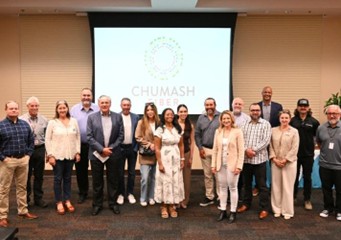
The Chumash’s last-mile project includes approximately 13 miles of underground fiber infrastructure and will offer a low-cost broadband plan. As customer installations continue, the project demonstrates how California’s middle-mile investment can support last-mile networks in bringing reliable, high-speed internet to communities that have historically lacked access.
For more on the celebration and the Chumash Tribe’s broadband journey, read the full story here.
Installation Updates as of mid-August
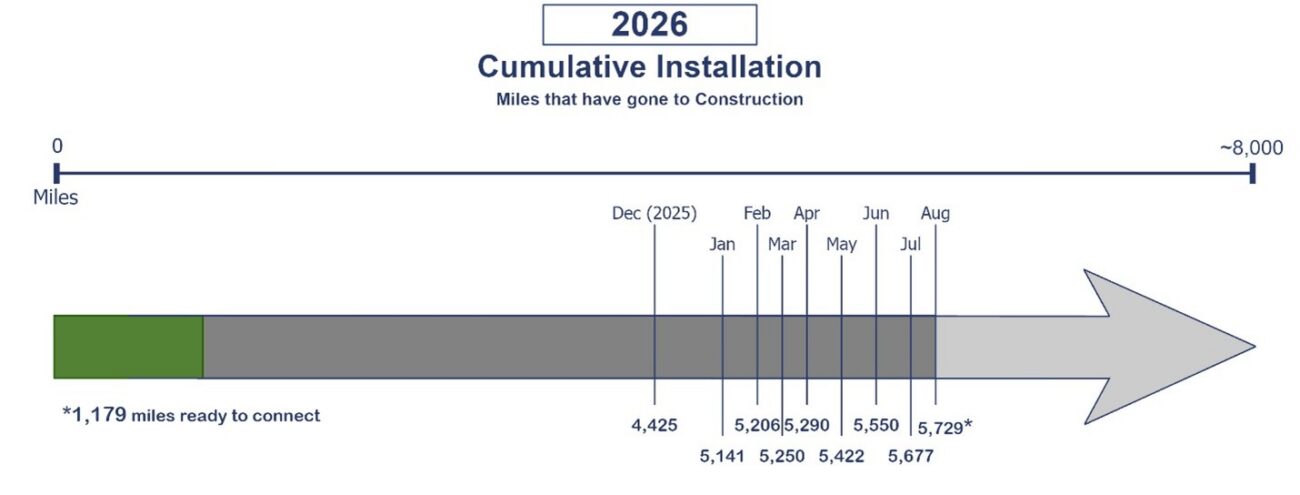
The MMBI continues to make progress across the state. Below is a snapshot of the network’s status as of mid-August 2026:
MMBI by the Numbers
- Total network miles: 8,209
- All 58 counties reached
- Miles in preconstruction phase: 2,480
- Miles in installation phase: 4,550
- Miles Ready-to-Connect: 1,179
- 9 tribal partnerships
Breakdown of Updates as of August 2026:
Hut Highlights:
MMBI now has 61 hut sites in construction:
- As of July, 53 huts were under construction in various counties.
- In August, construction was started on another 8 huts in Stanislaus, Siskiyou, Alameda, Mariposa, Mendocino, Lassen, and Solano counties.
Last Mile Program Update
Broadband Equity, Access, and Deployment Program
California’s Broadband Equity, Access, and Deployment (BEAD) Final Proposal for awards to applicants selected through the BEAD Subgrantee Selection Process was approved on July 17, 2026, by the NTIA.
Draft Resolution T-17920 outlining the revisions made to the state’s BEAD Final Proposal since its original submission on December 19, 2025, was published for public comment and may be considered by the Commission as soon as September 17, 2026.
For the most up-to-date information, please visit the California BEAD Final Proposal webpage.
Grant Opportunities
Upcoming Broadband Grant Opportunities
Four California Advanced Services Fund (CASF) grant programs have upcoming application windows. Interested entities can prepare to apply to these California Public Utilities Commission (CPUC) programs:
- Broadband Infrastructure Grant Account – October 1, 2026
- Tribal Technical Assistance Account – October 1, 2026
- Broadband Adoption Account – January 1, 2027
- Broadband Public Housing Account – January 1, 2027
Additionally, the CPUC’s Digital Divide Grant Program is accepting applications until October 30, 2026.
California Advanced Services Fund
Nearly $32 Million in New Funding for Broadband Infrastructure and Adoption
New CASF funding was awarded in August for projects that expand broadband access through adoption programs and infrastructure across California. These grants support digital literacy and call center projects, public housing broadband infrastructure, and last-mile projects located in Fresno, Merced, Plumas, and Tulare counties.
- CPUC Approves Nearly $32 Million to Expand Broadband Access (press release August 13, 2026)
For the most up to date information, please visit the California Advanced Services Fund website.
Last Mile Federal Funding Account
The Last Mile Federal Funding Account broadband infrastructure projects continue to progress through construction into service delivery throughout California. Read about several initiatives recently featured in the CPUC’s Community Impact Series:
- Tolowa Dee-ni’ Nation Last Mile Broadband Deployment Project Improves Tribal Governance (August 18, 2026)
- Question and Answer with Eric Votaw CEO of VARCOMM Broadband (August 19, 2026)
Find more broadband impact stories in the California Connectivity Story Series, including initiatives from the City of Ukiah and Santa Ynez Band of Chumash Indians.
Broadband Affordability Update
LifeLine Home Broadband Pilot Program
The California LifeLine Home Broadband Pilot Program, which launched in January 2026, expands access to affordable broadband internet in California. Eligible customers may apply the California LifeLine subsidy to either a $20 monthly discount for standalone broadband, or $30 for broadband bundled with (wireline or wireless) voice service from the same provider. More than a dozen broadband providers are currently enrolling eligible customers, and additional providers are working with the CPUC to participate.
This search tool allows the public to search for participating providers by zip code: Provider Search – California LifeLine.
To learn more, please visit the CPUC’s California LifeLine Home Broadband Pilot Program web page for more information including customer eligibility and provider procedures.
State Digital Equity Plan Updates
August Digital Equity Community of Practice Recap
Thanks to all the digital inclusion partners and stakeholders who attended the August Digital Equity Community of Practice. For those who missed this meeting, highlights included:
- CDT’s spotlighting of Community Updates
- Regional / Local Digital Navigation Panel featuring:
- Eduardo Gonzalez, Co-Founder / Co-Executive Director, Rural Prosperity Center, Digital Navigator Alliance
- Sandra Winter, Executive Director, Senior Coastsiders
- Abraham Camez, Digital Navigator, Hoopa Valley Public Utilities District
- Digital Navigation Training & Services discussion showcasing Digital Inclusion Partners:
- Marissa Canche, Director of Broadband Adoption, California Emerging Technology Fund (CETF)
- Sabrina Tam, Associate Director of Programs, digitalLIFT
- AJ Middleton, Senior Vice President of Impact, Human-I-T
- A demonstration by CDT on how to fill out the Digital Inclusion Partnership Tools and Resources Sign-Up Form.
Additionally, CPUC provided updates on the California LifeLine Home Broadband Pilot Program and went over the offered bundled services. CDT also shared updates on the Digital Equity Resource Finder, available outreach materials and resources, and upcoming grant opportunities.
Find past meeting recordings, presentations, and minutes on Broadband for All: Past Events.
Register for the next Community of Practice on Thursday, September 24 at 10:30 a.m. via Zoom.
Tools and Resources
Access Free Digital Inclusion Resources Across California
CDT is partnering with seven nonprofit organizations to deliver free digital inclusion tools, training, and services to community-based organizations statewide. This initiative is designed to strengthen the digital capacity of local and tribal governments, libraries, schools, nonprofits, and others working directly with residents.
Organizations can take advantage of offerings such as digital inclusion program management training, digital navigation training for staff, digital literacy assessment tools, AI skills training, all aimed at expanding equitable access to technology and digital opportunities.
If your organization is ready to support community digital inclusion efforts, we encourage you to complete the Digital Tools and Resources Sign-Up Form to be connected with services.
Digital Equity Resource Finder
California’s Digital Equity Resource Finder is a statewide tool that helps residents find digital inclusion programs right in their communities, such as assistance in enrolling affordable home internet, obtaining free or low-cost devices, digital skills training, and more. The Resource Finder is searchable by location and updated by organizations across the state. Know someone who needs support getting connected? Send them to the Digital Equity Resource Finder.
Help promote the Digital Equity Resource Finder using email, newsletter, and social media templates in the Outreach Toolkit.
Low-Cost Offer Finder Tool
To find affordable broadband service and computing devices, CDT has partnered with Everyone On to help California residents find affordable service programs in their area by zip code.
The low-cost offer finder tool provides access to low-cost internet services, computer equipment, and digital skills training.
Broadband for All Portal Funding Finder
The funding finder tracks broadband deployment, adoption, and digital literacy funding opportunities as they become available. Find these opportunities here.
Upcoming Events
**Find materials from past events. See future calendar events.
| Date | Time | Event | Locations and Links |
| Thursday, September 24, 2026 | 10:30 a.m. – 12:00 p.m. | Digital Equity Community of Practice (Virtual) | Register on Zoom |
| Friday, October 16, 2026 | 10:00 am – 12:00 pm | Middle-Mile Advisory Council Meeting (Hybrid) | Sacramento County Administration Center 700 H St., 1st Floor, Sacramento, CA 95814 Meeting Details |
| Friday, October 23, 2026 | 9:30 am – 11:30 am | California Broadband Council Meeting (Hybrid) | Sacramento County Administration Center 700 H St., 1st Floor, Sacramento, CA 95814 Zoom Webinar |
Job Opportunities
The California Department of Technology is hiring across many teams to support Broadband for All. Apply using the link below.
Keep an eye on other CDT Broadband job postings and CPUC job postings. Visit CalCareers for more information and to apply for open positions.


